Pages Menu
Categories Menu

Posted by on sep 4, 2015

Boek Makerspaces in Libraries verschenen!

Boek Makerspaces in Libraries verschenen!

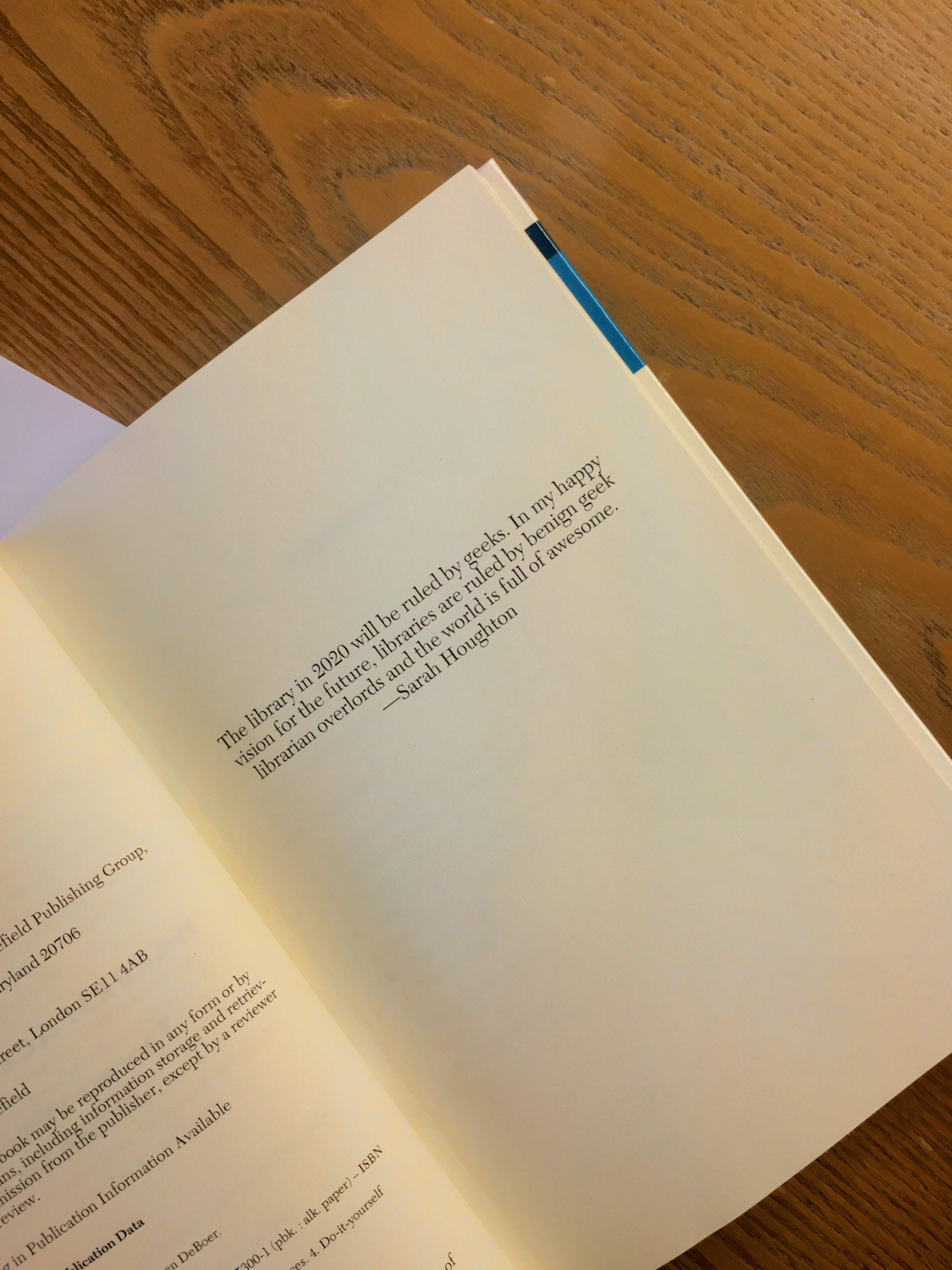
Afgelopen jaar werkte ik samen met mijn Amerikaanse collega Terri Willingham aan het boek Makerspaces in Libraries. Wij werden hiervoor benaderd door Ellyssa Kroski. Zij kwam op mijn spoor door een Skype-presentatie vanuit de FryskLab-truck die ik gaf voor Computers in Libraries (Washington, 2014). Ellyssa verzorgde voor uitgever Rowman & Littlefield de redactionele begeleiding van de reeks Library Technology Essentials waarvan ook ons boek deel uitmaakt.

Van de week is Makerspaces in Libraries uitgekomen en belandden ook een aantal exemplaren op mijn deurmat. Geweldig! Naar alle waarschijnlijkheid verzorgen Terri en ik begin oktober een webinar voor Library Journal. Daarnaast ben ik erin geïnteresseerd ook een Nederlandstalige versie te schrijven. Eventuele suggesties voor uitgevers zijn daarom van harte welkom.

En de eerste mooie recensie is al verschenen!

2015-09-01 08.40.39 HDR

2015-09-01 08.39.51 HDR

2015-09-01 08.41.45 HDR

2015-09-01 08.38.58 HDR

Read More

Posted by on aug 20, 2015

IFLA doet aanbevelingen over privacy in de bibliotheek

IFLA doet aanbevelingen over privacy in de bibliotheek

Zo, dit is goed! De International Federation of Library Associations and Institutions (IFLA) heeft een verklaring opgesteld die gaat over het bewaken van privacy van bibliotheekgebruikers:

This new Statement on Privacy in the Library Environment is intended to give guidance to libraries and information services in an environment that includes mass surveillance by governments and routine user data collection by commercial interests that provide content or services through the Internet. Risks to library users’ privacy might arise through their use of search or social media applications on the Web or their use of library platforms and content that collect data on end users.

De volledige verklaring lees je hier (PDF): IFLA Statement on Privacy in the Library Environment.

Aanbevelingen:

  • Library and information services should respect and advance privacy both at the level of practices and as a principle.
  • Library and information services should support national, regional and international level advocacy efforts (e.g. by human rights and digital rights organisations) to protect individuals’ privacy and their digital rights and encourage library professionals to reflect on these issues.
  • Library and information services should reject electronic surveillance and any type of illegitimate monitoring or collection of users’ personal data or information behaviour that would compromise their privacy and affect their rights to seek, receive and impart information. They should take measures to limit collection of personal information about their users and the services that they use.
  • While government access to users ́ data and data surveillance cannot be completely avoided, library and information services should ensure that intrusion in users’ information or communications by government is based on legitimate principles for such practices and necessary and proportionate to legitimate aims (e.g. described in “International Principles on the Application of Human Rights to Communications Surveillance”).
  • When library and information services provide access to resources, services or technology that may compromise users’ privacy, libraries should encourage users to be aware of the implications and provide guidance in data protection and privacy protection.
  • Library and information services should support their users’ ability to make informed choices, take legitimate actions and weigh risks and benefits in their communications and use of services on the Internet.
  • Data protection and privacy protection should be included as a part of the media and information literacy training for library and information service users. This should include training on tools to use to protect their privacy.
  • The education of library and information professionals should include data and privacy protection principles and practices in a networked environment.

Afbeelding: Nodeswitch via Compfight cc

Read More

Posted by on jul 31, 2015

Oogkleppen voor dames die vooruitgang schuwen

Oogkleppen voor dames die vooruitgang schuwen

Witgoedfabrikant Electrolux trachtte in 1932 huisvrouwen op onderstaande wijze te prikkelen om toch vooral een vooruitstrevende koelkast in hun keuken te tolereren.

bron: Boing Boing

Electrolux oogkleppen

Afbeelding: neonzu1 via Compfight cc

Read More

Posted by on jul 29, 2015

Tor in de bieb

Tor in de bieb

Afgelopen jaar konden bibliotheken inschrijven op een subsidiemogelijkheid van de Knight Foundation. Eén van de terecht gehonoreerde initiatieven was het Library Freedom Project (LFP) van Alison Macrina. Doel ervan is bibliotheekgebruikers via een reeks workshops te wijzen op hun digitale rechten, in het bijzonder privacy.

Lezers van mijn blog zullen begrijpen waarom ik dit initiatief van harte ondersteun. Een workshop van LPF die vandaag m’n aandacht trok deel ik daarom graag met jullie. Het gaat over het aanbieden van de privacyvriendelijke, maar tegelijktijdig controversiële Tor-browser in bibliotheken: Tor exit relays in libraries. Heel in het kort gaat het daarbij om het volgende:

“When a user opens the Tor Browser and navigates to a website, her traffic is bounced over three relays, scrambling her traffic with three layers of encryption, making her original IP address undetectable. The exit relay is the last relay in this circuit, the one that talks to the public internet. Fast, stable exit relays are vital to the strength of the Tor network. Non-exit relays – guards, middle relays, and bridges – are also important to the Tor network, but exit nodes are the most needed, and libraries can afford some of the legal exposure that comes with an exit. It’s not dangerous to run an exit, but because the exit node is the only identifiable one on the circuit, exit operators might face the occasional DMCA notice or law enforcement officer inquiring about traffic on the node. Since libraries already provide public internet services, we are protected by from DMCA takedowns by safe harbor provisions and are shielded from the threats that an individual exit relay operator might face in trying to explain to law enforcement that the traffic leaving her exit is not her own.”

Een hele mooi match tussen burgerrechten, mediawijsheid en de krachtige positie die bibliotheken hierin (kunnen?) vervullen. Hieronder voor de volledigheid een artikel van Macrina over het gebruik van Tor.

Ik heb het al meermaals gezegd, maar is het niet hoog tijd dat Nederlandse bibliotheken hierin samen optrekken met Bits of Freedom? De link die Jeanine Deckers vandaag rondstuurde over de informatiebijeenkomst over de nieuwe Wet Inlichtingen- en Veiligheidsdiensten, 11 augustus aanstaande, kon haast niet op een beter moment komen.

Alison Macrina: The Tor Browser and Intellectual Freedom in the Digital Age by Jeroen de Boer

Afbeelding: Jack Keene via Compfight cc

Read More

Posted by on mei 10, 2015

Een papieren backup van je ebook in de boekenkast

Een papieren backup van je ebook in de boekenkast

Het is een al wat ouder project, maar zeker niet minder relevant. Kunstenaar Jesse England besloot een papieren backup van een Kindle-ebook te maken: E-Book backup. England besloot hiertoe omdat hij zich zorgen maakt over de oncontroleerbare macht van content providers. Aldus England:

“In most instances, I think new electronic media is wonderful. For all their disadvantages, streaming and on-demand media has enabled young or amateur content creators to compete with established publishers unlike ever before. Older or out-of-print works can be newly disseminated with little overhead. I do not fear electronic media; I fear an invisible hand ever at the ready to pull back what I have already purchased for my self.”

England maakt de backup eenvoudigweg door zijn Kindle op het kopieerapparaat te leggen. De uitgeprinte pagina’s bindt hij vervolgens samen zodat zijn papieren ebook ook in de boekenkast kan staan. Om zijn actie kracht bij te zetten gebruikte hij George Orwell’s 1984. Die titel werd in 2009 door Amazon eenzijdig van alle Kindles verwijderd.

9_ebookbackup4

9_newbookdocumentation1

9_ebookbackup5

bron: Laughing Squid

Read More

Posted by on mei 9, 2015

Thomas Edison’s pratende poppen uit 1890 tot leven gewekt

Thomas Edison’s pratende poppen uit 1890 tot leven gewekt

Het verzamelaarsduo Robin en Joan Rolfs bezit twee pratende poppen die in 1890 kortstondig werden geproduceerd door het bedrijf van Thomas Edison. Kortstondig overigens omdat kinderen de poppen die een waxcilinder bevatten, maar eng vonden klinken.

Thomas-Edison-Talking-Doll

Gezien de korte productietijd zijn er maar weinig exemplaren van in omloop, waarbij het ook nog eens zo is dat de cilinders erg kwetsbaar bleken. Daarom bewaarden de Rolfs’s hun poppen in een kast, totdat wetenschappers bij het Lawrence Berkeley National Laboratory een methode bedachten om de cilinders uit te lezen zonder ze te beschadigen met de naald. Met een microscoop werden de groeven gedetailleerd uitgelezen, waarna de opnames gereconstrueerd konden worden.

Hieronder twee resultaten daarvan. Luister hier naar alle tot nu toe gereconstrueerde opnames. Prachtig dit soort dingen!

bron: Smithsonian

Read More

Pin It on Pinterest